

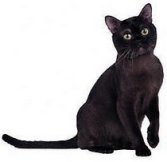

Burmese Cat: History, Temperament & Health Issues
The Burmese At A Glance:
Place Of Origin: Myanmar (Formerly Burma)
Dates Of Origin: 1930's
Average Weight Range: 8-14 lbs.
Temperament Of The Burmese: Friendly And Relaxed.
Breed Colors Of The Burmese: Sable, Champagne, Blue, Platinum.
*One of the top 10 friendliest cat breeds.
Place Of Origin: Myanmar (Formerly Burma)
Dates Of Origin: 1930's
Average Weight Range: 8-14 lbs.
Temperament Of The Burmese: Friendly And Relaxed.
Breed Colors Of The Burmese: Sable, Champagne, Blue, Platinum.
*One of the top 10 friendliest cat breeds.
The American Burmese is fond of human company but is less vocal or demonstrative than other Oriental breeds. This breed has a rounder head than its European counterpart. The extremely round, "contemporary" look was developed in the 1970's; unfortunately, so was the Burmese head fault, an inherited skull deformity that is often lethal.
History Of The Burmese:
The Burmese begins with Wong Mau, a Burmese-Siamese hybrid from Myanmar (formerly Burma), brought to the United States in 1930. A natural Tonkinese, Wong Mau was bred to a Siamese, and the kittens bred back to Wong Mau. Three types emerged: Siamese pointed; dark brown with minimal pointing (the first true Burmese); and a dark body with darker points, like Wong Mau.
Common Burmese Health Issues:
Cherry Eye
Cleft Palate: This is a birth defect of the nasal and oral cavities commonly associated with harelip. It is caused by failure of the palate bones to develop and fuse. This results in an opening from the oral to the nasal cavity. It is usually impossible for a kitten to nurse. Survival depends on tube feeding. A similar condition can occur in adult cats from a blow to the face associated with a fracture of the palate. Harelip can occur by itself. It is due to abnormal development of the upper lip. This problem is primarily cosmetic, and can be corrected with plastic surgery.
Psychogenic Alopecia: Abnormal hair loss that can be caused excessive self grooming. Similar to obsessive cumpulsive disorder in humans, Psychogenic Alopecia is caused by stress in your cat. This stress can be caused by other cats in the same house, people whom the cat dislikes, and/or separation anxiety. If your cat had an early history of abuse, he may also be prone to psychogenic alopecia. Treatment can include antidepressants, or simply separating the cat from its stressful environment. Or, you can attempt to enrich the cat's environment with toys, climbing equipment, providing a room with a view, even installing a fish tank. Be sure to determine first though, if your cat's alopecia is psychological and not caused by parasites, ringworm, pregnancy, or a hormonal imbalance.
History Of The Burmese:
The Burmese begins with Wong Mau, a Burmese-Siamese hybrid from Myanmar (formerly Burma), brought to the United States in 1930. A natural Tonkinese, Wong Mau was bred to a Siamese, and the kittens bred back to Wong Mau. Three types emerged: Siamese pointed; dark brown with minimal pointing (the first true Burmese); and a dark body with darker points, like Wong Mau.
Common Burmese Health Issues:
Cherry Eye
Cleft Palate: This is a birth defect of the nasal and oral cavities commonly associated with harelip. It is caused by failure of the palate bones to develop and fuse. This results in an opening from the oral to the nasal cavity. It is usually impossible for a kitten to nurse. Survival depends on tube feeding. A similar condition can occur in adult cats from a blow to the face associated with a fracture of the palate. Harelip can occur by itself. It is due to abnormal development of the upper lip. This problem is primarily cosmetic, and can be corrected with plastic surgery.
Psychogenic Alopecia: Abnormal hair loss that can be caused excessive self grooming. Similar to obsessive cumpulsive disorder in humans, Psychogenic Alopecia is caused by stress in your cat. This stress can be caused by other cats in the same house, people whom the cat dislikes, and/or separation anxiety. If your cat had an early history of abuse, he may also be prone to psychogenic alopecia. Treatment can include antidepressants, or simply separating the cat from its stressful environment. Or, you can attempt to enrich the cat's environment with toys, climbing equipment, providing a room with a view, even installing a fish tank. Be sure to determine first though, if your cat's alopecia is psychological and not caused by parasites, ringworm, pregnancy, or a hormonal imbalance.
Skull, Jaw, and Tooth Malformations (In Contemporary-Type Breeds Only)
Vestibular Disease: The vestibular system is a network of nerves in the ear, brain, and spinal cord that govern balance and orientation. Older cats may suffer from Vestibular Disease; symptoms include loss of balance, dizzyness, head tilting, eye drift, and falling. There is no known cause, and the condition is hereditary. Treatment: Some cases will disappear within 1 to 6 weeks with little or no treatment, although motion sickness medication may be prescribed. Determining treatment for more serious cases requires extensive testing; see your vet.
Vestibular Disease: The vestibular system is a network of nerves in the ear, brain, and spinal cord that govern balance and orientation. Older cats may suffer from Vestibular Disease; symptoms include loss of balance, dizzyness, head tilting, eye drift, and falling. There is no known cause, and the condition is hereditary. Treatment: Some cases will disappear within 1 to 6 weeks with little or no treatment, although motion sickness medication may be prescribed. Determining treatment for more serious cases requires extensive testing; see your vet.
Pet Meds: Dogs | Pet Meds: Cats | Dog Health : By Breed | Cat Health : By Breed | Dog Grooming | Cat Grooming | Pet Top 10's | Pet Food Recipes

Pet Meds: Dogs Pet Meds: Cats Common Dog Health Issues Common Cat Health Issues Dog Grooming Cat Grooming Pet Top 10's
Pet Health:Home
Copyright 2006-2011 PetMedsOnline.Org