
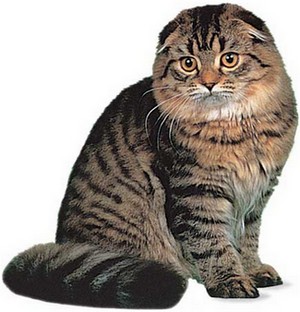


Scottish Fold Cat Breed: History, Temperament & Health Issues
The Scottish Fold At A Glance:
Place Of Origin: Scotland
Dates Of Origin: 1961
Average Weight Range: 6-13 lbs.
Temperament Of The Scottish Fold: Quietly Confident
Breed Colors Of The Scottish Fold: All colors and patterns, including pointed, sepia, and mink.
One of the top 10 least friendliest cats.
The longhaired Scottish Fold is best seen in winter, when it sports an imposing ruff, elegant britches, and a huge fluffy tail. Kittens are born with straight ears, which begin to fold at about three weeks of age. The joint problems that result from breeding fold-to-fold appear at four to six months: a short, thickened tail is a sign that might be missed in a longhaired kitten, so tails should be checked carefully - and always gently.
Place Of Origin: Scotland
Dates Of Origin: 1961
Average Weight Range: 6-13 lbs.
Temperament Of The Scottish Fold: Quietly Confident
Breed Colors Of The Scottish Fold: All colors and patterns, including pointed, sepia, and mink.
One of the top 10 least friendliest cats.
The longhaired Scottish Fold is best seen in winter, when it sports an imposing ruff, elegant britches, and a huge fluffy tail. Kittens are born with straight ears, which begin to fold at about three weeks of age. The joint problems that result from breeding fold-to-fold appear at four to six months: a short, thickened tail is a sign that might be missed in a longhaired kitten, so tails should be checked carefully - and always gently.
Common Scottish Fold Health Issues:
Epiphora (Excessive Tearing): Relatives of the Persian and Himalayans are generally more prone to chronic eye irritations and infections that produce tearing and staining of the hair below the eyes. Antibiotics such as Tetracycline are usually prescribed. See cat eye health for more about eye disorders in cats.
Extreme Sensitivities To Anesthetics, Vaccines, And Pesticides.
Osteodystrophy: A purely genetic abnormality, in which certain bones are deformed from birth, specifically legs and tail vertebrae. The only cure is responsible breeding, i.e. never breeding one Scottish Fold with another.
Sinus Conditions, Specifically Sinusitis: Infection of the frontal sinuses can occur with some frequency,
Epiphora (Excessive Tearing): Relatives of the Persian and Himalayans are generally more prone to chronic eye irritations and infections that produce tearing and staining of the hair below the eyes. Antibiotics such as Tetracycline are usually prescribed. See cat eye health for more about eye disorders in cats.
Extreme Sensitivities To Anesthetics, Vaccines, And Pesticides.
Osteodystrophy: A purely genetic abnormality, in which certain bones are deformed from birth, specifically legs and tail vertebrae. The only cure is responsible breeding, i.e. never breeding one Scottish Fold with another.
Sinus Conditions, Specifically Sinusitis: Infection of the frontal sinuses can occur with some frequency,
History Of The Scottish Fold:
All Scottish Folds can be traced back to Susie, a white farm cat born in 1961 in Scotland. Two geneticists found that Susie carried the longhair gene, which could be carried in shorthaired offspring and appear in later generations. The fold is still rare: the absence of any longhaired outcross breed makes the longhaired version even rarer.
All Scottish Folds can be traced back to Susie, a white farm cat born in 1961 in Scotland. Two geneticists found that Susie carried the longhair gene, which could be carried in shorthaired offspring and appear in later generations. The fold is still rare: the absence of any longhaired outcross breed makes the longhaired version even rarer.
as a secondary effect of a respiratory infection. Watch for a nasal discharge (often just on one side) accompanied by frequent sneezing and sniffling. Sinus issues are usually confirmed with an X-Ray showing increased density in the sinus(es), and are treated with an appropriate antibiotic. If this is not successful, a surgical procedure to make an opening into the sinus through the skin to aid in drainage may be required. See respiratory and sinus disorders for more information.
Pet Meds: Dogs | Pet Meds: Cats | Dog Health : By Breed | Cat Health : By Breed | Dog Grooming | Cat Grooming | Pet Top 10's | Pet Food Recipes

Pet Meds: Dogs Pet Meds: Cats Common Dog Health Issues Common Cat Health Issues Dog Grooming Cat Grooming Pet Top 10's
Pet Health:Home
Copyright 2006-2011 PetMedsOnline.Org