

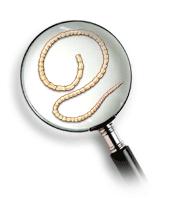
Tapeworms can live in dogs for years without doing serious harm. But they do irritate the intestine, eat food the dog should be getting, and if the dog gets sick they can mean the difference between life and death.
Treatments For Tapeworms In Dogs:
For puppies above or equal to three weeks: Drontal Plus
For puppies above or equal to four weeks: Droncit or D-Worm
For puppies above or equal to six weeks: Panacur or SafeGuard
Dogs above 7 weeks: Cestex
Treatments For Tapeworms In Dogs:
For puppies above or equal to three weeks: Drontal Plus
For puppies above or equal to four weeks: Droncit or D-Worm
For puppies above or equal to six weeks: Panacur or SafeGuard
Dogs above 7 weeks: Cestex
It is difficult to raise puppies worm-free. The type of worm may vary from area to area, but generally worms are a common problem and all pups should by checked for them at the time of adoption or purchase. This check requires laboratory and microscopic examination of a stool sample from the pet and can be done by a veterinarian, who will want to determine if parasites are present before planning a vaccination program. The most common types of worms in dogs are the roundworm, hookworm, whipworms, heartworms, and tapeworms.
Internal Parasites (Worms) In Dogs: Symptoms And Treatments
Treatments For Roundworm In Dogs:
Puppies at or above two weeks: ProWormer-2 or Nemex-2
Puppies above or equal to three weeks: Drontal Plus
Puppies above or equal to four weeks: Interceptor or Sentinal
Puppies above or equal to six weeks: Hartz Advanced Care Liquid Wormer or Sergeants Worm Away
Dogs above 8 weeks: Diethylcarbamazine (Only compounded products available)
Puppies at or above two weeks: ProWormer-2 or Nemex-2
Puppies above or equal to three weeks: Drontal Plus
Puppies above or equal to four weeks: Interceptor or Sentinal
Puppies above or equal to six weeks: Hartz Advanced Care Liquid Wormer or Sergeants Worm Away
Dogs above 8 weeks: Diethylcarbamazine (Only compounded products available)
Pet Meds: Dogs | Pet Meds: Cats | Dog Health : By Breed | Cat Health : By Breed | Dog Grooming | Cat Grooming | Pet Top 10's | Pet Food Recipes

Roundworms
Roundworms are one of the most common intestinal parasites for dogs (and cats). Although the infested dog (especially older) will often show no symptoms, a stool check will tell if the dog is infested, and there are several medication available for treatment of the problem.
Roundworms are one of the most common intestinal parasites for dogs (and cats). Although the infested dog (especially older) will often show no symptoms, a stool check will tell if the dog is infested, and there are several medication available for treatment of the problem.
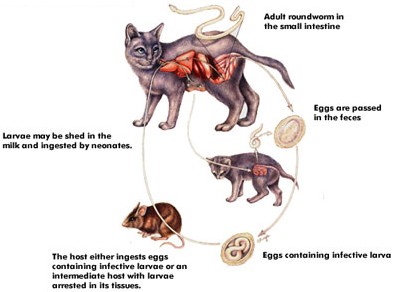
Symptoms Of Worms
The symptoms, if any, which the parasitized dog may show will vary with the degree and type of infestation. Once the veterinarian has determined which type of parasite is present, he will prescribe the preferred medicine indicated for treatment of your dog.
The symptoms, if any, which the parasitized dog may show will vary with the degree and type of infestation. Once the veterinarian has determined which type of parasite is present, he will prescribe the preferred medicine indicated for treatment of your dog.
Hookworms
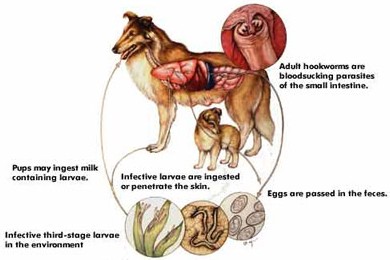
Hookworms take a deadly toll of puppies. Often, the puppies get them from their mothers before birth. Some may die within two weeks, others will begin to show serious illnes at five or six weeks. Again, a stool check is required to verify infestation, and the vet will want to prescribe medication and start treatment as quickly as possible.
Hookworms take a deadly toll of puppies. Often, the puppies get them from their mothers before birth. Some may die within two weeks, others will begin to show serious illnes at five or six weeks. Again, a stool check is required to verify infestation, and the vet will want to prescribe medication and start treatment as quickly as possible.
Whipworms
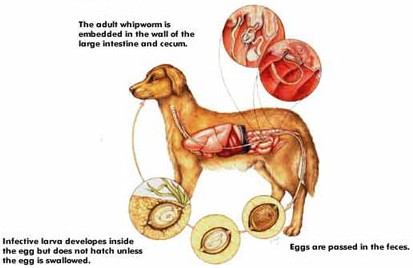
A stool check is also required to verify whipworm infestation. These worms are difficult to eliminate. They are much more apt to strike kennel dogs than pet dogs, but they do reach both. A dog can become infected by consuming food or water infected with whipworm eggs. After the eggs are swallowed, they will hatch and burrow into the intestinal wall and feed on blood.
A stool check is also required to verify whipworm infestation. These worms are difficult to eliminate. They are much more apt to strike kennel dogs than pet dogs, but they do reach both. A dog can become infected by consuming food or water infected with whipworm eggs. After the eggs are swallowed, they will hatch and burrow into the intestinal wall and feed on blood.
Treatments For Whipworms In Dogs:
For puppies above or equal to three weeks: Drontal Plus
For puppies above or equal to four weeks: Interceptor or Sentinal
For puppies above or equal to six weeks: Panacur or SafeGuard
For puppies above or equal to three weeks: Drontal Plus
For puppies above or equal to four weeks: Interceptor or Sentinal
For puppies above or equal to six weeks: Panacur or SafeGuard
Heartworm
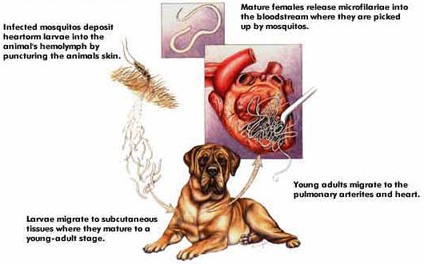
Dogs can be infested with heartworm for years before showing symptoms. They contract the condition by the bite of an infected mosquito, similar to how malaria is spread. The larva burrows into a dog's skin, and take about three months to mature. Once they do, they make their way to the heart and surrounding tissues, and mate. Once the population gets large enough, it destroys its host. Because the worm primarily affects the heart, signs of infection can be a general lethargy in the animal, constant
Dogs can be infested with heartworm for years before showing symptoms. They contract the condition by the bite of an infected mosquito, similar to how malaria is spread. The larva burrows into a dog's skin, and take about three months to mature. Once they do, they make their way to the heart and surrounding tissues, and mate. Once the population gets large enough, it destroys its host. Because the worm primarily affects the heart, signs of infection can be a general lethargy in the animal, constant
coughing, and laboured breathing. Swelling of the legs can also be present. If you even suspect heartworm in your dog, get him to the vet immediately for the proper tests and treatments. In some severe cases, surgery may be required to remove the worms, but this is rare.
Treatments For Heartworm In Dogs:
Interceptor, Sentinel, Heartgard Plus, Tri-Heart Plus, Iverhart Plus
Interceptor, Sentinel, Heartgard Plus, Tri-Heart Plus, Iverhart Plus
Treatments For Hookworm In Dogs:
Puppies at or above two weeks: ProWormer-2 or Nemex-2
Puppies above or equal to three weeks: Drontal Plus
Puppies above or equal to four weeks: Interceptor or Sentinal
For puppies above or equal to six weeks: Panacur, SafeGuard, Heartgard Plus, Tri-Heart Plus or Iverhart Plus
Puppies at or above two weeks: ProWormer-2 or Nemex-2
Puppies above or equal to three weeks: Drontal Plus
Puppies above or equal to four weeks: Interceptor or Sentinal
For puppies above or equal to six weeks: Panacur, SafeGuard, Heartgard Plus, Tri-Heart Plus or Iverhart Plus
Tapeworms
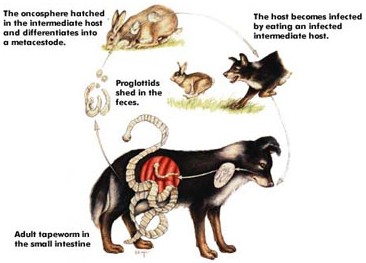
Tapeworms are common in older dogs. At one stage in their life cycles tapeworms are carried in fleas, which live on dogs, cats and humans. If a dog swallows a flea, the tapeworm eggs can hatch and develop. Other species are transmitted when a dog ingests tapeworms cysts located in other animals i.e. by eating uncleaned rabbits, sheep or deer carcasses. Tapeworm segments break off and are eliminated with the dog's stools, in which you can observe the small, rectangular segments, providing proof of infestation.
Tapeworms are common in older dogs. At one stage in their life cycles tapeworms are carried in fleas, which live on dogs, cats and humans. If a dog swallows a flea, the tapeworm eggs can hatch and develop. Other species are transmitted when a dog ingests tapeworms cysts located in other animals i.e. by eating uncleaned rabbits, sheep or deer carcasses. Tapeworm segments break off and are eliminated with the dog's stools, in which you can observe the small, rectangular segments, providing proof of infestation.
Find And/Or Search For These Brands Here.
Find And/Or Search For These Brands Here.
Find And/Or Search For These Brands Here.
Find And/Or Search For These Brands Here.
Find And/Or Search For These Brands Here.
Pet Meds: Dogs Pet Meds: Cats Common Dog Health Issues Common Cat Health Issues Dog Grooming Cat Grooming Pet Top 10's
Pet Health:Home
Copyright 2006-2011 PetMedsOnline.Org
Online Store For Dogs!
Find everything from basic grooming items and tasty treats, to high tech devices designed for pets!
Find everything from basic grooming items and tasty treats, to high tech devices designed for pets!
Pet Top Lists!
From the friendliest cat breeds to the most intelligent dogs, you'll find it all on our "pet top list" pages!
From the friendliest cat breeds to the most intelligent dogs, you'll find it all on our "pet top list" pages!


