

Elbow Dysplasia In Dogs:
Which Breeds Can Be Affected?
Mostly large breeds of dogs suffer from elbow dysplasia, breeds such as the Great Pyrenees, Retrievers, St.Bernard, Weimaraner, Newfoundland Dog, Irish Wolfhound, Mastiff, German Shepherd, Afghan Hound and more.
How Do I Know My Dog Has Elbow Dysplasia?
Your dog's symptoms may be quite subtle in the beginning, and you may not notice any lameness or indicators of pain at first. But if you do, it will most likely be right after your dog gets up, or starts to run or walk. If you or your vet suspect a problem, an examination, x-ray and/or CT scan will be performed. The earlier the problem is diagnosed, the better.
How Will My Veterinarian Treat The Disorder?
Usually, surgery is recommended to remove the cartilage or bone fragment(s) that are the source of the problem. Surgery may also help to relieve pressure if unequal bone growth is the cause. After surgery, anti-inflammatory medications may be prescribed to help with any discomfort.
Mostly large breeds of dogs suffer from elbow dysplasia, breeds such as the Great Pyrenees, Retrievers, St.Bernard, Weimaraner, Newfoundland Dog, Irish Wolfhound, Mastiff, German Shepherd, Afghan Hound and more.
How Do I Know My Dog Has Elbow Dysplasia?
Your dog's symptoms may be quite subtle in the beginning, and you may not notice any lameness or indicators of pain at first. But if you do, it will most likely be right after your dog gets up, or starts to run or walk. If you or your vet suspect a problem, an examination, x-ray and/or CT scan will be performed. The earlier the problem is diagnosed, the better.
How Will My Veterinarian Treat The Disorder?
Usually, surgery is recommended to remove the cartilage or bone fragment(s) that are the source of the problem. Surgery may also help to relieve pressure if unequal bone growth is the cause. After surgery, anti-inflammatory medications may be prescribed to help with any discomfort.
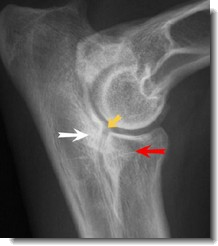
Above:
Elbow Dysplasia
Yellow Arrow:
Space Between Ulna And Radius
Red Arrow:
Missing Cranial Border Of Coronoid Process
White Arrow:
Osteoarthrosis Of The Ulnar Bone
Elbow Dysplasia
Yellow Arrow:
Space Between Ulna And Radius
Red Arrow:
Missing Cranial Border Of Coronoid Process
White Arrow:
Osteoarthrosis Of The Ulnar Bone
Elbow Dysplasia is a disease which can affect both front legs of your dog. It may be caused by osteochondritis dissecans, an abnormality in the maturation of cartilage. It is an inherited condition, but other factors like activity, trauma and/or diet can have a role in its development. This disorder, left untreated, can lead to complete lameness.
Pet Meds: Dogs | Pet Meds: Cats | Dog Health : By Breed | Cat Health : By Breed | Dog Grooming | Cat Grooming | Pet Top 10's | Pet Food Recipes

Pet Meds: Dogs Pet Meds: Cats Common Dog Health Issues Common Cat Health Issues Dog Grooming Cat Grooming Pet Top 10's
Pet Health:Home
Copyright 2006-2011 PetMedsOnline.Org

Online Store For Dogs!
Find everything from basic grooming items and tasty treats, to high tech devices designed for pets!
Find everything from basic grooming items and tasty treats, to high tech devices designed for pets!
Pet Top Lists!
From the friendliest cat breeds to the most intelligent dogs, you'll find it all on our "pet top list" pages!
From the friendliest cat breeds to the most intelligent dogs, you'll find it all on our "pet top list" pages!
