

Slipped Disc Disease In Dogs:
Breeds Susceptible To Slipped Discs:
The breeds more susceptible to disc disease include Dachshunds, Pekingese, Cocker Spaniels, Miniature and Toy Poodles, Beagles, and Corgis.
The breeds more susceptible to disc disease include Dachshunds, Pekingese, Cocker Spaniels, Miniature and Toy Poodles, Beagles, and Corgis.
Causes Of Disc Disease:
The discs between the vertebrae degenerate with age. In some breeds the degeneration starts very early - even from a few months of age.
The central part (or nucleus) of a diseased disc can suddenly rupture and put pressure on the spinal cord, thus jamming the nerves against the roof of the bone tunnel through which the spinal cord runs. The ruptured nucleus causes extreme irritation and marked inflammation occurs where disc material has extruded. Inflammation greatly increases the pressure on the spinal cord. Depending on the amount of pressure, the dog experiences pain, weakness, loss of sensation and in severe cases, paralysis.
Treatment For A "Slipped Disc":
The idea that a slipped disc can be pushed back into place is not true. The disc has burst and cannot be manipulated back.
Things Your Vet Can Do:
1. Relieve the pressure that results from the inflammatory reaction that follows rupture of the disc. This is achieved usually by resting the dog, plus using cortisone and other drugs such as mannitol to reduce pressure within the spinal canal.
2. Surgery (called disc fenestration) to remove the disc material.
3. Surgery to remove the roof of the spinal canal, therefore releasing the pressure on the spinal cord. This surgery must be undertaken within 24 hours of the disc rupture for the best chance of success.
The discs between the vertebrae degenerate with age. In some breeds the degeneration starts very early - even from a few months of age.
The central part (or nucleus) of a diseased disc can suddenly rupture and put pressure on the spinal cord, thus jamming the nerves against the roof of the bone tunnel through which the spinal cord runs. The ruptured nucleus causes extreme irritation and marked inflammation occurs where disc material has extruded. Inflammation greatly increases the pressure on the spinal cord. Depending on the amount of pressure, the dog experiences pain, weakness, loss of sensation and in severe cases, paralysis.
Treatment For A "Slipped Disc":
The idea that a slipped disc can be pushed back into place is not true. The disc has burst and cannot be manipulated back.
Things Your Vet Can Do:
1. Relieve the pressure that results from the inflammatory reaction that follows rupture of the disc. This is achieved usually by resting the dog, plus using cortisone and other drugs such as mannitol to reduce pressure within the spinal canal.
2. Surgery (called disc fenestration) to remove the disc material.
3. Surgery to remove the roof of the spinal canal, therefore releasing the pressure on the spinal cord. This surgery must be undertaken within 24 hours of the disc rupture for the best chance of success.
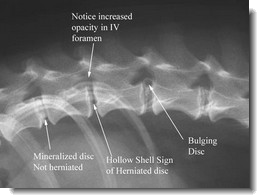
Above: A Typical "Slipped Disc".
Between each of the vertebrae is a shock absorber called a "disc". This shock absorber absorbs the pressures when the dog bends, runs or jumps, and allows movement of what would otherwise be a rigid spinal column.
Pet Meds: Dogs | Pet Meds: Cats | Dog Health : By Breed | Cat Health : By Breed | Dog Grooming | Cat Grooming | Pet Top 10's | Pet Food Recipes

Pet Meds: Dogs Pet Meds: Cats Common Dog Health Issues Common Cat Health Issues Dog Grooming Cat Grooming Pet Top 10's
Pet Health:Home
Copyright 2006-2011 PetMedsOnline.Org

Online Store For Dogs!
Find everything from basic grooming items and tasty treats, to high tech devices designed for pets!
Find everything from basic grooming items and tasty treats, to high tech devices designed for pets!
Pet Top Lists!
From the friendliest cat breeds to the most intelligent dogs, you'll find it all on our "pet top list" pages!
From the friendliest cat breeds to the most intelligent dogs, you'll find it all on our "pet top list" pages!
