

Third Eyelid In Dogs: Health Issues
Haws (Prominent Third Eyelid):
The third eyelid can become more prominent due to many causes - some involving the eye - but sometimes due to conditions affecting the whole body such as intestinal worms in pups. The third eyelid appears as a "skin" covering the inner part of the eye, usually about a quarter to half of the eye being covered. Dog owners often mistakenly report that their dog has a "growth covering the eye".
Treatment:
A prominent third eyelid is usually only one sign that there is eye disease or body disease. A veterinary examination determines the cause.
If The Third Eyelid Is Persistantly Prominent, Should It Be Removed Surgically?
Absolutely not. The third eyelid is vital for a dog's healthy vision and should never be removed. If the third eyelid is removed, tear production is reduced and later the eye can become dry and very sick.
Pink Third Eyelid:
Lack of dark pigment makes a third eyelid appear prominent as it contrasts with the eyeball behind it. Although tatooing and - alas- removal has been advocated, it is much better to breed the problem out.
The third eyelid can become more prominent due to many causes - some involving the eye - but sometimes due to conditions affecting the whole body such as intestinal worms in pups. The third eyelid appears as a "skin" covering the inner part of the eye, usually about a quarter to half of the eye being covered. Dog owners often mistakenly report that their dog has a "growth covering the eye".
Treatment:
A prominent third eyelid is usually only one sign that there is eye disease or body disease. A veterinary examination determines the cause.
If The Third Eyelid Is Persistantly Prominent, Should It Be Removed Surgically?
Absolutely not. The third eyelid is vital for a dog's healthy vision and should never be removed. If the third eyelid is removed, tear production is reduced and later the eye can become dry and very sick.
Pink Third Eyelid:
Lack of dark pigment makes a third eyelid appear prominent as it contrasts with the eyeball behind it. Although tatooing and - alas- removal has been advocated, it is much better to breed the problem out.
Cherry Eye In Dogs:
There is a gland at the base of the third eyelid. Normally, this gland is small and tucked well out of our sight. The gland may fall out of position and bulges out at the corner of the eye. This swelling is termed "cherry eye". Breeds predisposed include Cocker Spaniels, Bassetts and Beagles. In mild cases of cherry eye the gland of the third eyelid can be returned to its correct position by the owner with the fingers. Surgery is usually needed, however. The gland is stitched back into position and not removed, as it is vital for tears.
There is a gland at the base of the third eyelid. Normally, this gland is small and tucked well out of our sight. The gland may fall out of position and bulges out at the corner of the eye. This swelling is termed "cherry eye". Breeds predisposed include Cocker Spaniels, Bassetts and Beagles. In mild cases of cherry eye the gland of the third eyelid can be returned to its correct position by the owner with the fingers. Surgery is usually needed, however. The gland is stitched back into position and not removed, as it is vital for tears.
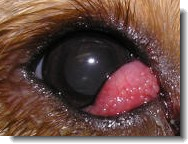
Above: "Cherry Eye" or Everted Third Eyelid In Dogs.
What Is The Third Eyelid In Dogs? What Does It Do? The third eyelid, or nictitating (winking) membrane is a protective extra eyelid at the inner corner of each eye, next to the nose. When needed, the third eyelid can sweep across the eyeball, like a windshield wiper, to help remove debris.
Pet Meds: Dogs | Pet Meds: Cats | Dog Health : By Breed | Cat Health : By Breed | Dog Grooming | Cat Grooming | Pet Top 10's | Pet Food Recipes

Pet Meds: Dogs Pet Meds: Cats Common Dog Health Issues Common Cat Health Issues Dog Grooming Cat Grooming Pet Top 10's
Pet Health:Home
Copyright 2006-2011 PetMedsOnline.Org

Online Store For Dogs!
Find everything from basic grooming items and tasty treats, to high tech devices designed for pets!
Find everything from basic grooming items and tasty treats, to high tech devices designed for pets!
Pet Top Lists!
From the friendliest cat breeds to the most intelligent dogs, you'll find it all on our "pet top list" pages!
From the friendliest cat breeds to the most intelligent dogs, you'll find it all on our "pet top list" pages!
